 in your browser, then choose "Add to Home Screen".
Chess is a game for two players who move white and black pieces, and you win by trapping your opponent's king. This article covers the rules you need to play your first game.
Contents
What kind of game is chess?
- On a board of 8×8 squares, White and Black take turns moving one piece at a time.
- When you move to a square where an opponent's piece is, you capture that piece. Captured pieces are taken off the board. Unlike in shogi, you can't use them as your own pieces.
- The goal is to put your opponent's king in a position where it can't escape (checkmate). Even if you capture lots of pieces, you don't win unless you checkmate.
Setting up the board and pieces
- Place the board so that the square in the bottom-right corner is white (the light color) from your side.
- Each player has 16 pieces (1 king, 1 queen, 2 rooks, 2 bishops, 2 knights, and 8 pawns).
- On the row closest to you, from the edge: rook, knight, bishop, queen, king, bishop, knight, rook. Put the 8 pawns on the row in front of them.
- The queen goes on her own color (the white queen on a light square, the black queen on a dark square).
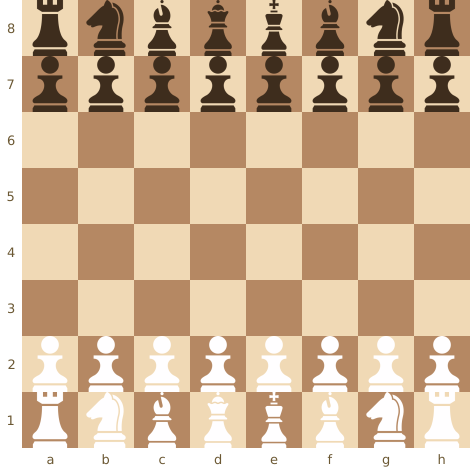 The bottom-right square (h1) is light. The white queen (d1) goes on a light square, and the black queen (d8) on a dark square.
Learn more in "How to Set Up a Chessboard."
How the 6 kinds of pieces move
| Piece | How it moves |
|---|---|
 King |
One square in any direction |
 Queen |
Any number of squares straight or diagonally |
 Rook |
Any number of squares straight (up, down, left, right) |
 Bishop |
Any number of squares diagonally |
 Knight |
To the square "2 squares straight, then 1 square to the side." It can jump over pieces |
 Pawn |
One square forward (2 squares on its first move only). It captures one square diagonally forward |
Except for the knight, a piece can't go past another piece in its way.
Learn more in "How Chess Pieces Move." How strong each piece is is covered in "Chess Piece Values."
White moves first
- In chess, White moves first.
- This is the opposite of shogi, so be careful if you know shogi.
- You move only one piece per turn. You can't pass.
Special rules
Chess has three special moves that work differently from ordinary moves.
- Castling: You move the king and a rook at the same time to tuck the king safely toward the edge. → "What Is Castling?"
- En passant: You can capture an opponent's pawn that moved 2 squares, even after it has passed by. → "What Is En Passant?"
- Promotion: When a pawn reaches the far end of the board, it turns into a queen or another piece. → "What Is Pawn Promotion?"
Winning, losing, and draws
- You win: when you checkmate the opponent's king, when your opponent resigns (admits defeat), or when your opponent runs out of time. → "What Is Checkmate?"
- It's a draw: stalemate (no legal moves, but not in check), the same position three times, the 50-move rule, not enough pieces left to checkmate, or when both players agree. → "Draws and Stalemate in Chess"
When I was a child, I learned checkmate the wrong way. I thought you won just by attacking the square the king was on.
Attacking the king's square is only "check." If the opponent can block with a piece, or capture your piece with the king, the game isn't over.
I'd think I had won, but the game would keep going, and before I knew it I had lost.
As an adult, I read the rulebook properly and fixed my mistake, but I'm still not good at driving the king into checkmate.
In the endgame, I'm always wondering how to "attack the king's square and every square it can move to" with my pieces.
If you have the same problem, be sure to check out "What Is Checkmate? How It Differs from Check, and the Basics of Winning" too.
Moves you can't make (illegal moves)
- You can't make a move that puts your own king where it can be captured, or a move that leaves your king in check.
- When playing on a real board, there's also etiquette such as moving the piece you touch (touch-move).
- On this site, you simply can't make an illegal move.
Time control
- In tournaments and on chess sites, each player often has a set amount of time. If you run out of time, you lose.
- On this site, you can also choose a timer when you start a new game (you can play without one, too).
Once you know the rules, play a game
- If you want to learn by moving pieces on the board, open "Board & Pieces" or "Tips & Results" from "Tutorial" in the menu.
- Two people can play each other on one phone or tablet, with family or friends.
- On your own, you can play a bot whose strength you choose from 10 levels. → "Chess Bot Strength in 10 Levels"
- Tips for starting to win are in "Chess Tips for Beginners."


