 in your browser, then choose "Add to Home Screen".
There are 6 kinds of chess pieces. This article introduces the name of each piece and how it moves, with diagrams. For readers who know shogi, there's also a table comparing them with shogi pieces.
Contents
The 6 kinds of pieces
| Piece | Symbol | Per player |
|---|---|---|
 King |
K | 1 |
 Queen |
Q | 1 |
 Rook |
R | 2 |
 Bishop |
B | 2 |
 Knight |
N | 2 |
 Pawn |
(none) | 8 |
- The symbols are the letters used in chess notation (the record of moves). The knight uses N so it isn't confused with the K of the king. → "How to Read Chess Notation"
- In Japan, the rook and the knight are sometimes called "castle" and "horse."
King
- It moves one square in any direction.
- It can't move to a square attacked by an opponent's piece (a square where it would be captured).
- When the king is about to be captured, that's check. When it can't escape, that's checkmate.
- There's a special move called castling, where the king and a rook move at the same time. → "What Is Castling?"
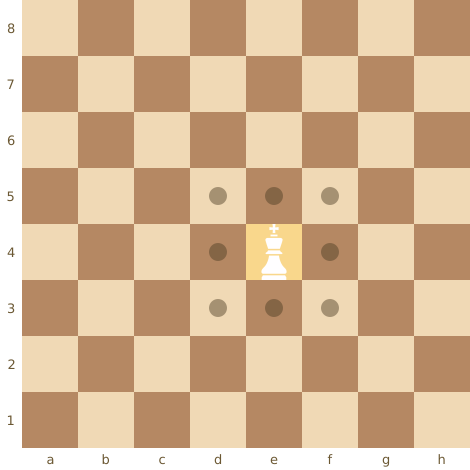 The king can move one square to any of the 8 squares around it.
Queen
- It moves any number of squares straight or diagonally. It combines the moves of the rook and the bishop.
- It's the piece that can move the most. → "Which Piece Is the Strongest?"
- It can't go past a piece in its way.
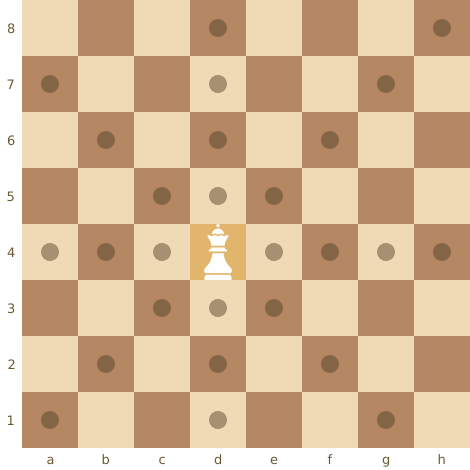 The queen can move as far as it likes along straight and diagonal lines.
Rook
- It moves any number of squares straight (up, down, left, or right).
- It moves the same way as the Hisha (rook) in shogi.
- It can't go past a piece in its way.
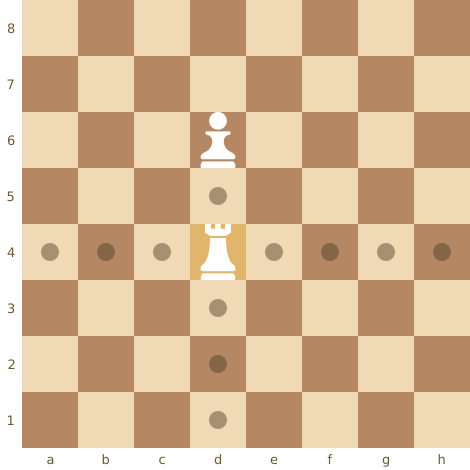 The rook moves straight. It can't go past its own pawn on d6 (to d7 or d8).
Bishop
- It moves any number of squares diagonally.
- It moves the same way as the Kaku (bishop) in shogi.
- Because it only moves diagonally, it can never leave the color of square it started on. Your two bishops are split into a light-square bishop and a dark-square bishop.
- It can't go past a piece in its way.
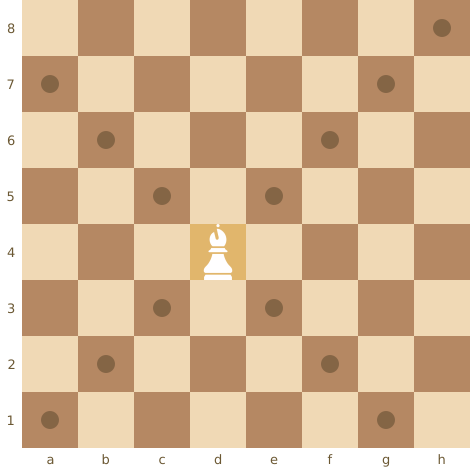 The bishop moves diagonally. It always stays on squares of the same color.
Knight
- It moves to the square "2 squares straight, then 1 square to the side." It's shaped like the letter L.
- It's the only piece that can jump over other pieces.
- It's similar to the Keima in shogi, but unlike the Keima, it can move in 8 directions: forward, backward, and sideways.
- Every time it moves, it switches between a light square and a dark square.
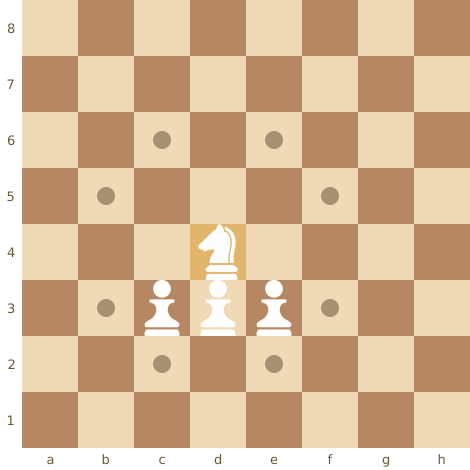 The knight can move to the 8 squares in an L shape. It can jump over pieces in its way.
Pawn
- It moves one square forward. It can't move backward or sideways.
- On its first move only, it can also move 2 squares.
- Only when capturing, it moves one square diagonally forward. It can't capture a piece straight ahead, and it's stuck if a piece is directly in front of it.
- When it reaches the far end of the board, it turns into a queen or another piece (promotion). → "What Is Pawn Promotion?"
- There's also a special rule called en passant, for capturing an opponent's pawn that moved 2 squares. → "What Is En Passant?"
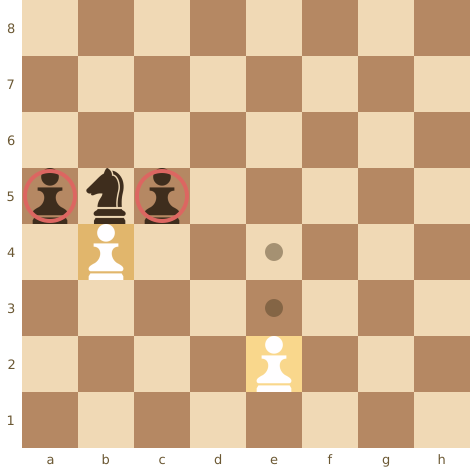 The pawn on e2 can go to e3 or e4. The pawn on b4 can't move forward because of the piece on b5, but it can capture the pieces on a5 and c5 diagonally ahead.
Compared with shogi pieces
| Chess | Closest shogi piece | Difference |
|---|---|---|
| King | Gyoku/Ō (king) | Same, but chess has castling. |
| Queen | (none) | Combines the moves of the Hisha and the Kaku. |
| Rook | Hisha | Same, but it doesn't promote. |
| Bishop | Kaku | Same, but it doesn't promote. |
| Knight | Keima | It can move in 8 directions, not just forward. |
| Pawn | Fu | It captures diagonally forward, can move 2 squares at first, and turns into a queen or another piece at the far end. |
Unlike in shogi, you can't use pieces you've captured.
Try the moves on a board
- In "Board & Pieces" under "Tutorial" in the menu, you can learn by moving the pieces.
- On the game screen, when you select a piece, dots appear on the squares it can move to.


