 in your browser, then choose "Add to Home Screen".
Writing like "1.e4 e5 2.Nf3" that you often see in chess explanations is called chess notation. Once you know the square names and the piece symbols, you can read it right away. This article covers how to read chess notation and what the symbols mean.
Contents
What is chess notation?
- It's a written record of the moves of a game, one move at a time. The most widely used system today is called algebraic notation.
- With the notation, you can replay the same game on a board later. Opening explanations and famous games are also written in notation.
- To save a game as a file, a format called PGN is used.
Square names (a1 to h8)
- From White's side, the columns are a to h from left to right (files), and the rows are 1 to 8 from near to far (ranks).
- A square is named "letter + number." For example, the white king starts on e1.
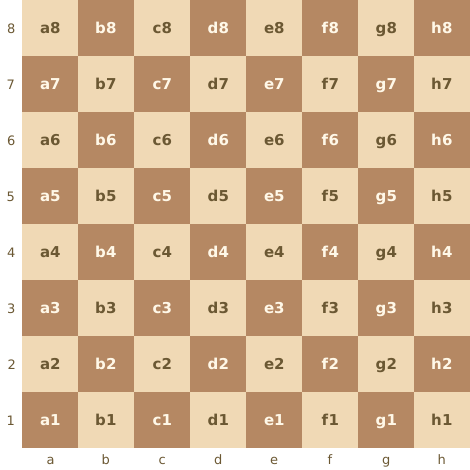 From White's side: a to h from left to right (files), 1 to 8 from near to far (ranks).
Learn more in "How to Set Up a Chessboard."
Piece symbols
| Piece | Symbol | Example | Meaning |
|---|---|---|---|
 King |
K | Ke2 | The king moves to e2 |
 Queen |
Q | Qh5 | The queen moves to h5 |
 Rook |
R | Rd1 | The rook moves to d1 |
 Bishop |
B | Bc4 | The bishop moves to c4 |
 Knight |
N | Nf3 | The knight moves to f3 |
 Pawn |
(none) | e4 | A pawn moves to e4 |
- For pawns, no symbol is written, only the destination square.
- The knight uses N to tell it apart from the K of the king.
- When two pieces of the same kind can both move to the same square, you add which one moved. Example: Nbd2 (the knight on the b-file moves to d2).
Capture x, check +, checkmate
| Symbol | Meaning | Example |
|---|---|---|
| x | Captures a piece | Bxf7 (the bishop captures the piece on f7) |
| + | Check | Qh5+ |
| # | Checkmate | Qxf7# (captures the piece on f7, with checkmate) |
- When a pawn captures, add the letter of the file it came from. Example: exd5 (the pawn on the e-file captures the piece on d5).
- In commentary, ! is sometimes added to a good move, ? to a bad move, and ?? to a blunder.
Castling O-O, promotion =Q
| Notation | Meaning |
|---|---|
| O-O | Kingside castling |
| O-O-O | Queenside castling |
| e8=Q | A pawn moves to e8 and becomes a queen |
- In books and on paper score sheets, castling is sometimes written with the number 0, as 0-0. → "What Is Castling?"
- For promotion, write the symbol of the new piece after =. → "What Is Pawn Promotion?"
How moves are numbered
- 1.e4 e5 means "move 1: White plays e4, Black plays e5." The move number goes up by one after each pair of moves by White and Black.
- When starting from a Black move, add "..." as in 1...e5.
Example: Scholar's Mate
1.e4 e5 2.Bc4 Nc6 3.Qh5 Nf6 4.Qxf7#
→ "Quick Checkmates in Chess and How to Stop Them"
How to read this site's move list
The move list on the game screen has three columns: move number, White's move, and Black's move.
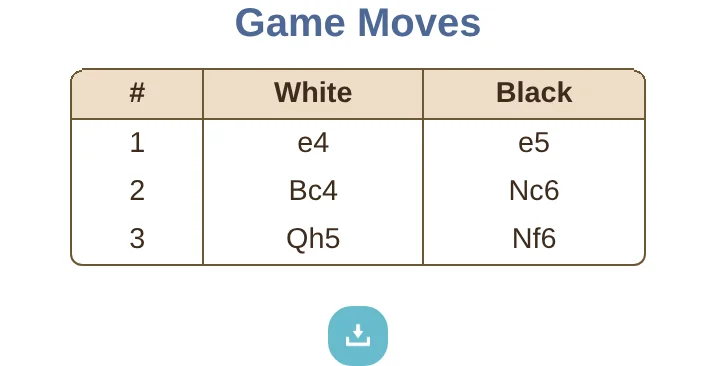 The move list on the game screen, after 1.e4 e5 2.Bc4 Nc6 3.Qh5 Nf6.
- You can download a game as PGN with the light-blue button below the list. It can be loaded into other chess sites and software.
- In AI analysis (sample analysis page), you can see which moves were good and which were bad, move by move.
- The Openings list and the Lessons also show moves in this notation.
When I got interested in chess and started reading chess books, almost all of the explanations were written in notation.
Books can't show a diagram for every move, so there are diagrams only every few moves, and the moves in between are written in notation.
Once I learned to read notation, I was amazed at how convenient it is!
Something that would need tons of illustrations fits in the space of one or two diagrams when written in notation.
I hear that advanced players can even play chess with just the written notation, without a board.
I'm nowhere near that level yet, but lately I've been hooked on reading the notation of famous past games and replaying them by playing both sides in the two-player mode.


