 in your browser, then choose "Add to Home Screen".
Castling is a special chess rule where you move the king and a rook at the same time in one move. It tucks the king safely toward the edge and brings the rook toward the center, where it can join the fight more easily. This article covers how to castle, when you can't, and why you do it.
Contents
What is castling?
- You move the king 2 squares toward a rook, and put that rook on the square next to the king, on the other side.
- Each player can castle only once per game.
- This is the only time the king can move 2 squares.
How to castle (kingside and queenside)
Kingside (short castling)
- White: king e1 → g1, rook h1 → f1
- Black: king e8 → g8, rook h8 → f8
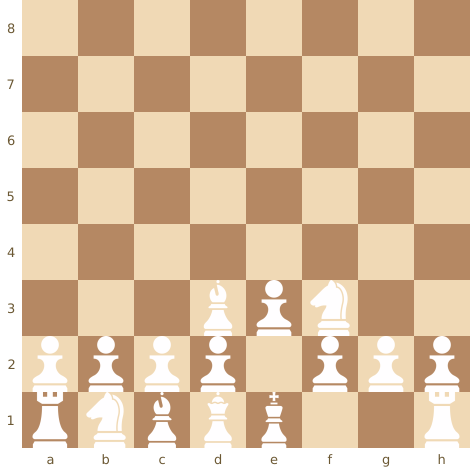 Before castling
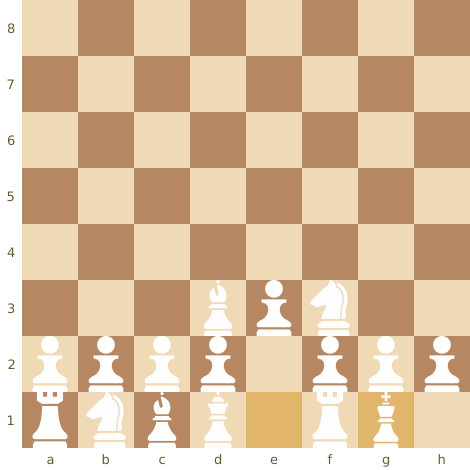 After castling
Queenside (long castling)
- White: king e1 → c1, rook a1 → d1
- Black: king e8 → c8, rook a8 → d8
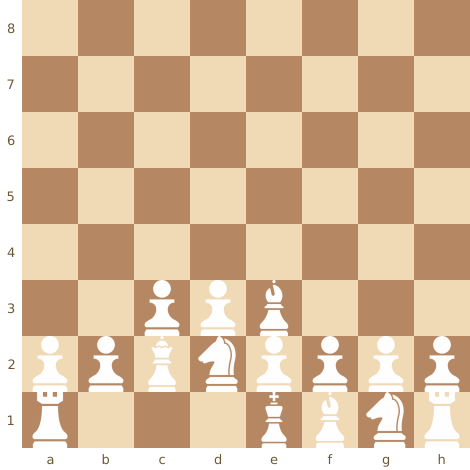 Before castling
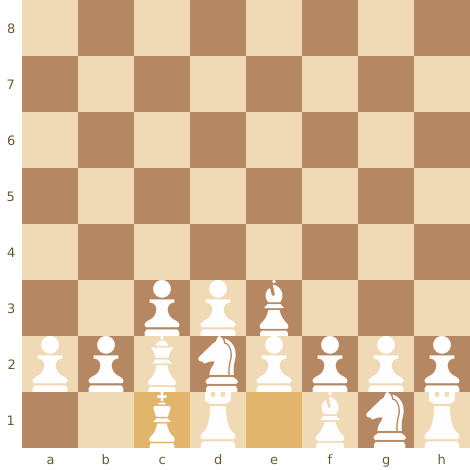 After castling
On the queenside, there are 3 squares between the king and the rook, so you first need to move the queen, bishop, and knight out of the way.
5 conditions when you can't castle
You can't castle if any of these is true.
- The king has already moved (even if it moved back to its starting square)
- That rook has already moved (you may still be able to castle with the other rook)
- There's a piece between the king and the rook (yours or your opponent's)
- The king is in check
- A square the king passes through or lands on is attacked by an opponent's piece
- Rule 5. is only about the squares the king passes through. Even if a square only the rook passes through (b1 or b8 on the queenside) is attacked, you can still castle.
- You can also castle if the rook is attacked.
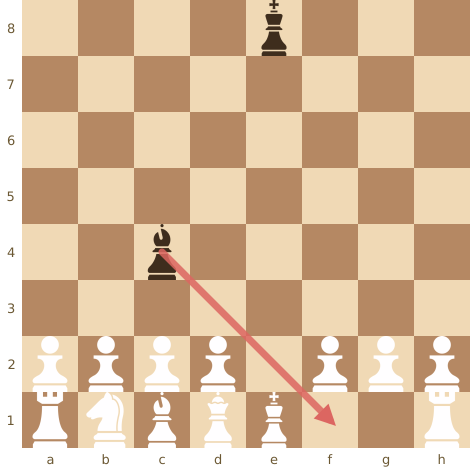 The black bishop on c4 attacks f1, a square the king passes through. In this position, White can't castle kingside.
In cases 4 and 5, instead of moving the king or rook carelessly (once they move, you can never castle with them), you can also block by putting another piece in between.
Moves 10 and 11 of Lesson No.002 are a good example. Black blocks White's check 10.Qh5+ by putting a pawn in between with 10...g6, then castles on the next move with 11...O-O.
Why castle? (The benefits)
- The king is safer: A king in the middle is easy to attack from the opening to the middlegame. Moving it toward the edge lets the pawns in front protect it.
- The rook joins the fight: The rook in the corner comes closer to the center, where it can attack the middle of the board more easily.
- "Castle early" is one of the principles of the opening. → "Recommended Chess Openings for Beginners"
Be careful
- If you carelessly move the pawns on the side where you castled (the f, g, and h pawns on the kingside), gaps open up around the king, making it easier to attack.
- On the other hand, if you never move them, the king can get trapped behind its pawns and checkmated from the side by a rook or queen (a "back-rank mate"). → "What Is Checkmate?"
0-0 and 0-0-0 in chess notation
- In chess notation, kingside castling is written 0-0, and queenside castling 0-0-0.
- In PGN (the file format for game records), the letter O is used instead of the number 0: O-O and O-O-O. This site's move list also uses O-O.
- Learn more in "How to Read Chess Notation."
How to castle on this site
- Move the king 2 squares, and the rook moves automatically (to g1 on the kingside, c1 on the queenside).
- When you can't castle, the square 2 squares away isn't shown among the king's possible moves.
- Castling in variants with different starting positions, such as "Chess960," isn't supported.


