 in your browser, then choose "Add to Home Screen".
An opening is the way you play the first moves of a chess game. This article introduces the openings beginners should learn first and the positions you'll often meet in games, split into openings for White and for Black.
Contents
What is an opening? Do I have to memorize it?
- An opening is a well-known way of playing the first moves that has been given a name (the Italian Game, the London System, and so on).
- In Japanese, openings are also called jōseki (定跡), the same word used in shogi.
- At first, you don't need to memorize the moves. Just following the "three principles of the opening" below makes it much less likely that you'll fall behind early.
- Learning one or two openings helps you reach the middlegame without getting lost.
As a beginner there was a lot to learn, so instead of trying to memorize many openings, I focused on the "three principles of the opening" below.
While your opponents are beginners or low-level bots, they won't necessarily play along with the opening you've learned.
So I first concentrated on understanding "what this opening is trying to do," and only started memorizing after I had leveled up.
Three principles of the opening
- Control the center: Take the middle of the board with pawns on e4 and d4 (e5 and d5 for Black).
- Bring out your pieces: Develop your knights and bishops early. Try not to move the same piece again and again.
- Castle early: Move your king to the edge to keep it safe. → "What Is Castling?"
Learn more in "Chess Tips for Beginners."
Which first move is best?
These are the four most common first moves for White.
| First move | What it does |
|---|---|
| e4 | Takes the center and opens lines for the bishop and queen. The most popular. The fight tends to start early. |
| d4 | Takes the center. Tends to lead to calmer positions than e4. |
| c4 | Aims at the center from the side (the English Opening). For advanced players. |
| Nf3 | Brings out a knight. Lets you see what your opponent does before choosing a setup. |
For beginners, we recommend e4 or d4.
Recommended openings for White
| Opening | Moves | Why we recommend it |
|---|---|---|
| Italian Game | 1.e4 e5 2.Nf3 Nc6 3.Bc4 | Follows the three principles directly. The idea of aiming at f7 is easy to understand |
| Scotch Game | 1.e4 e5 2.Nf3 Nc6 3.d4 | Trades pawns in the center early, giving your pieces more room |
| London System | 1.d4, Nf3, Bf4 | You can set up the same way almost no matter what your opponent plays. Less to memorize |
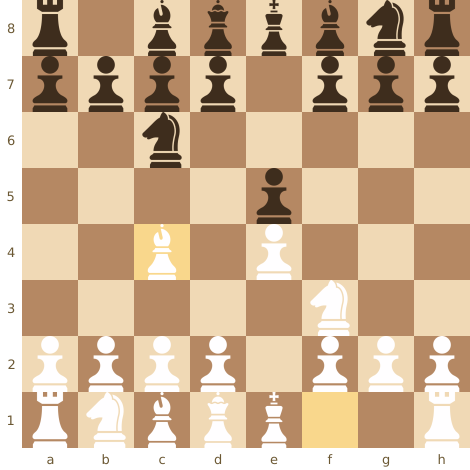 The Italian Game. The bishop on c4 aims at f7.
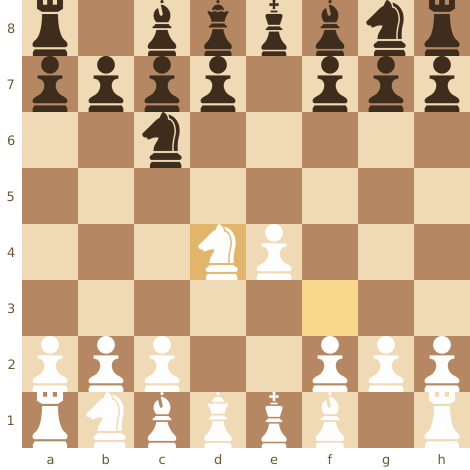 The Scotch Game. Pawns have been traded in the center, and a knight has come out to d4.
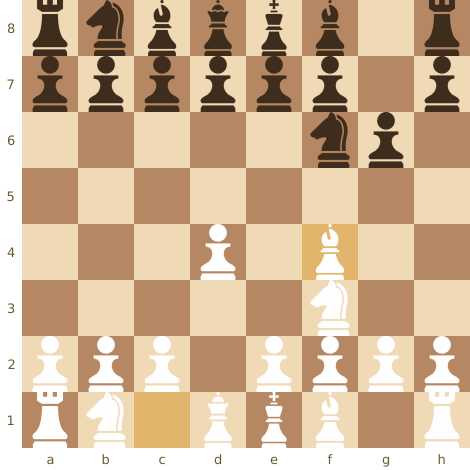 The London System. You always set up the same way with d4, Nf3, and Bf4.
Recommended openings for Black
When White plays e4
- 1...e5: Like White, take the center. You'll be facing the Italian Game or the Scotch Game from Black's side. Knowing White's setups makes Black easier to play, too.
- 1...d5: The Scandinavian Defense. Trade the central pawns right away to keep the position simple.
When White plays d4
1...d5: Take the center. If White plays 2.c4, one solid option is to defend with e6, as in the Queen's Gambit Declined.
Openings you'll often see
These are positions you'll often run into in games. Just knowing their names and which side chooses them makes it easier to read your opponent's plan.
1.e4 e5 2.Nf3 Nc6 is especially common. The game branches on White's third move: 3.Bb5 is the Ruy Lopez, 3.Bc4 is the Italian Game, and 3.d4 is the Scotch Game. Here, we include the Ruy Lopez as a typical example.
| Opening | Chosen by | Moves |
|---|---|---|
| Ruy Lopez | White | 1.e4 e5 2.Nf3 Nc6 3.Bb5. A classic, long-played opening |
| Sicilian Defense | Black | 1.e4 c5. One of the most common replies to e4. Tends to lead to sharp fights |
| Scandinavian Defense | Black | 1.e4 d5. Trades the central pawns right away |
| French Defense | Black | 1.e4 e6 2.d4 d5. Defends solidly, then counterattacks |
| Caro-Kann Defense | Black | 1.e4 c6 2.d4 d5. Similar to the French, and even more solid |
| Queen's Gambit (Declined, Accepted) | White | 1.d4 d5 2.c4. Offers the c-pawn to fight for the center |
Watch out for opening traps
- Early in the game, Black can get attacked on f7 by White's queen and bishop (or White on f2), and lose in just 4 moves (Scholar's Mate).
- To learn how to stop it, see "Quick Checkmates in Chess and How to Stop Them."
Learn on this site
- Openings: Replay the moves one at a time, with commentary. They're sorted by White and Black, and by beginner, intermediate, and advanced.
- Lessons: Watch bot-vs-bot games one move at a time, with commentary. Some games use the openings from the Openings list.
- Try out the openings you've learned against the bot. → "Chess Bot Strength in 10 Levels"


