 in your browser, then choose "Add to Home Screen".
You've learned chess, but you just can't seem to win… If that sounds like you, here are the tips beginners should focus on first. This article covers how to play the opening, how to avoid losing pieces, and ways to practice on your own.
Contents
Three principles of the opening
In the opening (the start of the game), just keeping these three things in mind makes the game much easier to play.
-
Control the center
The four squares e4, d4, e5, and d5 are the center of the board. Putting pawns and pieces in the center gives your pieces more room to move.
-
Bring out your pieces (development)
Move your knights and bishops off their starting squares early. Bringing out a piece that hasn't moved yet is more important than moving the same piece again and again.
-
Castle early
Castling moves your king to a safe spot near the edge and makes it easier for your rook to join the fight. Learn more in "What Is Castling?."
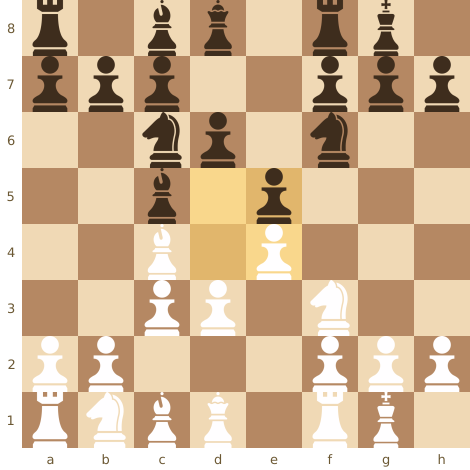 The four colored squares (d4, e4, d5, e5) are the center. Both White and Black have put pawns in the center, brought out their knights and bishops, and castled.
Ways of playing that follow these three principles have names, such as the "Italian Game." Openings we recommend for beginners are covered in "Recommended Chess Openings for Beginners," and the moves are shown in the "Openings" list.
Don't give away pieces for free
Beginners often lose because a piece gets captured and they can't win anything back. Before you move a piece, check these two things.
-
Can the piece be captured on its new square?
See whether an opponent's piece can reach that square, and if it can, whether one of your pieces is defending it.
-
Does the move leave another piece undefended?
See whether a piece that this piece was defending can now be captured for free.
If a piece is captured but you can take back a piece worth about the same, you don't lose anything. Piece values are explained in "Chess Piece Values: Which Piece Is the Strongest?."
When I first started playing chess, all I thought about was how to capture my opponent's pieces, and I kept losing to the bot.
I only started beating the bot little by little once I began always checking that my pieces were protecting each other.
When you move a piece, try checking whether it is protected by your other pieces, and whether any of your pieces are left unprotected.
And when you spot an unprotected piece of your opponent's, check that you won't lose a piece in return (that it isn't a trap), and then go ahead and take it!
Think about what your opponent is aiming for
After your opponent moves, before thinking about your own move, ask yourself, "Why did they play that?" Look for these three things.
- Are you in check?
- Is any of your pieces about to be captured?
- Is your opponent aiming for something next move (a fork, checkmate, and so on)?
If you only think about what you want to do, you won't notice your opponent's plan, and you'll lose pieces.
As a beginner, you don't have clear plans of your own yet, so working out your opponent's plan is really hard.
In my case, my guesses of "this is what I'd play next" were often wrong, and by the time I went "Oh!", I had usually already lost a piece.
After watching bot-vs-bot games with commentary in the Lessons, I started to see things like "I bet they'll play this next."
It's a quick way to learn to read your opponent's plans, so I recommend it.
Learn the common tactics
A tactic is a short sequence of one or a few moves that wins material or gives checkmate. Start by learning these three.
-
Fork (double attack)
One piece attacks two of your opponent's pieces at the same time. Knight forks come up often.
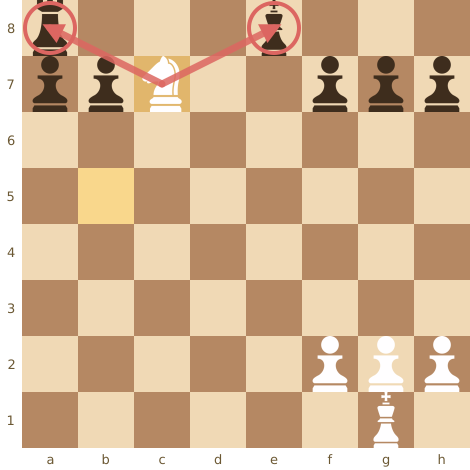 White's knight jumps to c7 and attacks the king and the rook at the same time. When the king moves away, White can take the rook.
-
Pin
You attack a piece that can't move, because moving it would let an important piece behind it be captured.
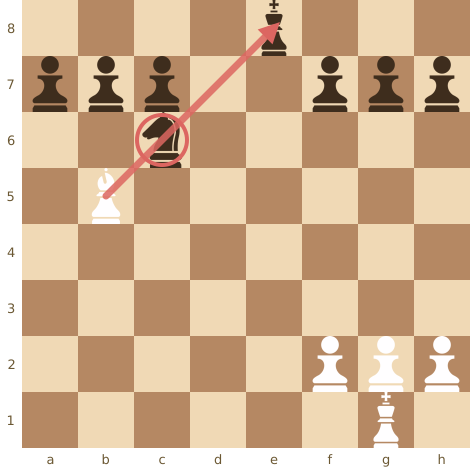 The bishop on b5 pins the knight on c6. If the knight moved, the king would be under attack, so the knight can't move.
-
Skewer
You attack an important piece, and when it moves away, you capture the piece behind it. It's the reverse of a pin.
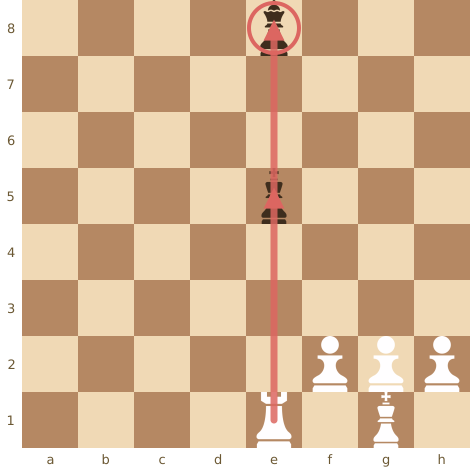 The rook on e1 checks the king. When the king moves off the e-file, White can take the queen behind it.
The fastest way to learn tactics is by solving problems. Try solving positions from real games in Puzzles for Everyone. Other tactics are covered in "Chess Tactics."
When you're ahead, trade pieces and keep it simple
When your pieces are worth more points than your opponent's (you're ahead in material), trading pieces of equal value makes it easier to win.
- The fewer pieces there are, the more the difference in points matters.
- The board gets simpler, and your opponent has fewer chances to turn the game around.
On the other hand, when you're behind in material, avoid trades and look for a chance to come back while there are still lots of pieces on the board.
Endgame tips
In the endgame, when few pieces are left, you need to think differently than in the opening.
-
Use your king in the fight too
The king that you protected in the opening becomes an important fighter in the endgame. It moves forward to protect your pawns and to stop your opponent's pawns.
-
Promote your pawns
When a pawn reaches the far end of the board, it can become a queen or another piece. In the endgame, pushing your pawns is the shortest path to winning.
-
Learn the basic checkmates
- Queen + King vs. King
- Rook + King vs. King
The key to the basic checkmates is driving your opponent's king to the edge of the board. Learn more in "What Is Checkmate?."
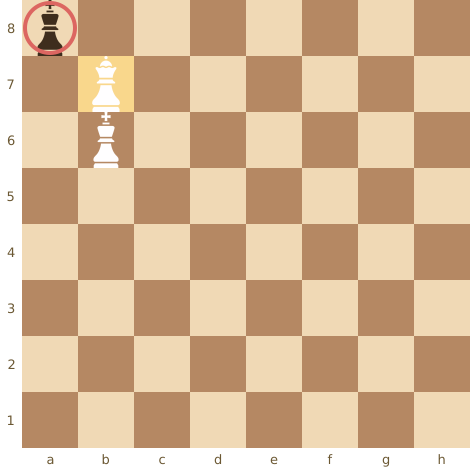 The queen (b7), protected by the king (b6), checkmates the king in the corner.
Even if you're ahead in material, the game can end in a draw (such as stalemate) if you don't know how to checkmate. Learn more in "Draws and Stalemate in Chess."
A common way to lose, and how to stop it
One way beginners often lose is the Scholar's Mate. White attacks the pawn on f7 (next to Black's king) with the queen and bishop and checkmates in four moves.
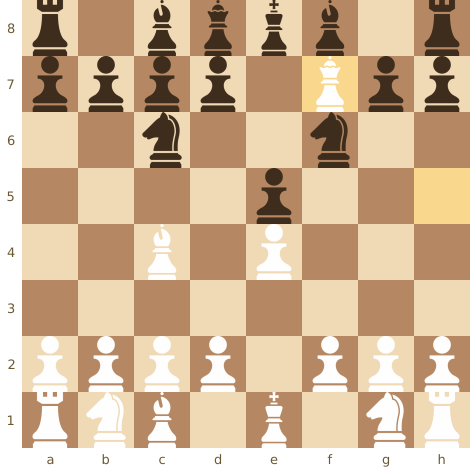 The position after 4. Qxf7#. The queen, protected by the bishop on c4, takes on f7 and gives checkmate.
To stop it, notice early that f7 is being targeted, and defend it. For example, against 3. Qh5, you can chase the queen away with 3... g6, or defend f7 with your queen with 3... Qe7.
In the opening, f7 (f2 for White) is a weak square that only the king defends. Always watch out for attacks on it. The Fool's Mate, which ends in two moves, and other quick checkmates are covered in "Quick Checkmates in Chess and How to Stop Them."
Ways to practice on your own
On this site, you can practice even by yourself.
-
Play against the bot
You can choose its strength from 10 levels. We recommend practicing at a level where you win about half your games. How to choose a level is explained in "Chess Bot Strength in 10 Levels."
-
Solve puzzles
You can solve tactics problems in Puzzles for Everyone.
-
Learn with lessons
In the Lessons, you can follow bot-vs-bot games one move at a time, read the commentary, and think about the next move together.
-
Look back with AI analysis
After a game, use AI analysis to find where you made mistakes. The games you lose are the ones you can learn the most from.
Here's the order we recommend: first, use the lessons to get a feel for how the pieces move and what your opponent is aiming for → play against the bot → look back with AI analysis, find what to fix, and work on it.
If your tactics score on the AI analysis "Skill Radar" isn't very good, try Puzzles for Everyone, or the player puzzles on My Account (available when you sign up).
Is there a way to always win?
No one has found a way to always win at chess.
There are so many possible positions in chess that even today's computers can't check them all. Even the strongest chess AI doesn't know a sequence of moves that always wins from the starting position.
That's why picking up the tips in this article little by little is the shortest path to winning.
Chess AI is covered in "What Is Stockfish? The Chess AI's Strength, How It Works, and How to Read Its Evaluation."


