 in your browser, then choose "Add to Home Screen".
This article is about Stockfish, the world's strongest chess AI, which this site uses. Stockfish is a chess engine that has won computer chess tournaments many times. You will learn whether humans or AI are stronger, how it chooses its moves, and how to read its evaluation.
Contents
What is Stockfish?
Stockfish is a program that thinks about chess moves (a chess engine). Give it a position, and it calculates which side is better and by how much (the evaluation), and the best move.
It has won the computer chess tournament TCEC 19 times so far (as of October 2026). Its rating (a number that shows strength) is over 3500 on CCRL, a rating list made from games between computers. That list is separate from human ratings, so the numbers cannot be compared directly, but it is far above the human world champion (in the 2800s).
Who is stronger, humans or AI?
Today, AI is much stronger.
In 1997, IBM's computer Deep Blue beat the world champion of the time, Garry Kasparov (May 1997, a six-game match with 2 wins, 1 loss and 3 draws). It was the first time a human world champion lost a match to a computer. Almost 30 years later, chess AI is so strong that even the human world champion can almost never beat it.
Stockfish is also different from AI that writes text, such as ChatGPT. Stockfish is a program made only for reading chess moves. It does not write text or hold conversations.
How does it think about moves?
Stockfish reads many moves ahead, spreading its thoughts out like the branches of a tree.
- From the current position, it lists every move it can play.
- For each of those moves, it lists every reply the opponent can play.
- Then its own next moves, the opponent's next moves, and so on, spreading the branches many moves ahead.
- It gives each position at the end of a branch a score (the evaluation) for which side is better and by how much.
- It works back from the ends of the branches to see "what happens if both sides play their best moves," and picks the best move to play now.
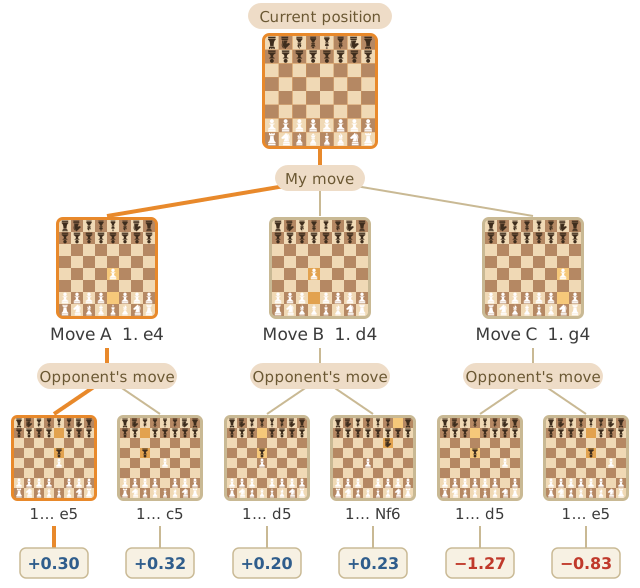 The opponent replies with the move that gives me (White) the lowest score. Move A (1. e4) leads to +0.30, move B (1. d4) to +0.20, and move C (1. g4) to −1.27, so the best move is move A (scores from Stockfish 17.1, depth 18).
But it cannot read every move to the very end. A chess game can go about 10120 different ways (the Shannon number), more than even the fastest computer can read. That is why no one has found a sure way to win at chess yet. Stockfish's best move is not "the perfect answer," but "the best move within what it can read now."
So it stops reading branches that look hopeless early, and reads promising branches more deeply. It keeps reading until it reaches a set time or depth, so the longer it thinks, the deeper it reads and the more accurate its moves become.
To score positions, it uses a neural network (NNUE) that has learned from a huge number of positions (since Stockfish 12 in September 2020).
What can it do?
Here is what you give Stockfish (input) and what it gives back (output).
| Input | The position (which piece is on which square, and whose turn it is) |
|---|---|
| How far to think (how many moves ahead to read, or how much time it may use) | |
| How many candidate moves to return |
| Output | The evaluation of the position (such as +1.5 or M3) |
|---|---|
| Candidate moves, best first | |
| For each move, the best play for both sides after it (the line) |
The position is given as one line of text called FEN. For example, the starting position is written like this:
rnbqkbnr/pppppppp/8/8/8/8/PPPPPPPP/RNBQKBNR w KQkq - 0 1
It starts from the top rank (Black's side, rank 8) and separates each rank with "/". A piece on a square is written with its letter (lowercase for Black, uppercase for White), and a run of empty squares is written as a number. The knight is N, not K.
Other information, such as whose turn it is and whether castling is still possible, is also written with letters only.
"How many moves ahead to read" is called depth. One White move and one Black move each count as 1. Instead of depth, you can also set a time, such as "think for up to so many seconds per position."
For example, let's give it this position (White to move) from Puzzles for Everyone.
5rk1/1p2p2p/rN2p1p1/p1qp4/4n3/2P1P3/PP3PPP/R2QK2R w KQ - 0 1
Asking for depth 18 and three candidate moves, it returned this (Stockfish 17.1):
| Candidate | Evaluation | Line |
|---|---|---|
| 1. Nd7 | +1.78 | Nd7 Qb5 Nxf8 Qxb2 O-O Kxf8 |
| 2. Na4 | −2.01 | Na4 Qc7 f3 Nd6 b3 b5 |
| 3. Nxd5 | −5.30 | Nxd5 exd5 O-O Raf6 f3 Qxe3+ |
The best move, Nd7, is a fork: the knight attacks Black's queen (c5) and rook (f8) at the same time. Its evaluation is more than 3 higher than the second move, so in this position Nd7 is the only good move.
How do you read an evaluation like +1.5?
The evaluation is a number that shows which side is better and by how much.
- Plus (+) means White is better, and minus (−) means Black is better. The closer to 0, the more equal the position.
- +1.0 means White is better by about one pawn. +3.0 is a difference of about one knight or bishop.
- When there is an M, as in M3, a checkmate has been found. "M3" means White can checkmate in 3 moves, and "−M3" means Black can. M stands for mate (checkmate).
The unit of the evaluation is the centipawn (one pawn = 100). +1.5 means 150 centipawns.
How is it different from piece values?
Chess pieces have rough point values: pawn 1, knight and bishop 3, rook 5, and queen 9.
| Piece | Points |
|---|---|
| Pawn | 1 |
| Knight | 3 |
| Bishop | 3 |
| Rook | 5 |
| Queen | 9 |
The evaluation from a chess AI is not decided by these piece values alone. It also includes how active the pieces are, whether the king is safe, whether the pawn structure is good, and more. So even with the same pieces on both sides, the evaluation can be +2.0.
How this site uses it
This site uses Stockfish for games against the Bot, game analysis, puzzles and lessons.
We play games with the candidate moves Stockfish returns, and use its evaluations for analysis.
Playing the Bot
We adjust the candidate moves Stockfish returns by how deeply it thinks.
Then we choose a move based on the Bot's level.
The weaker the level, the shallower it reads and the more candidate moves it returns, so it is more likely to pick a move with a low evaluation on purpose.
Game analysis
After a game, you can look back on it on the analysis page. For each move, you can see the best move and how the win rate changed (sample analysis page).
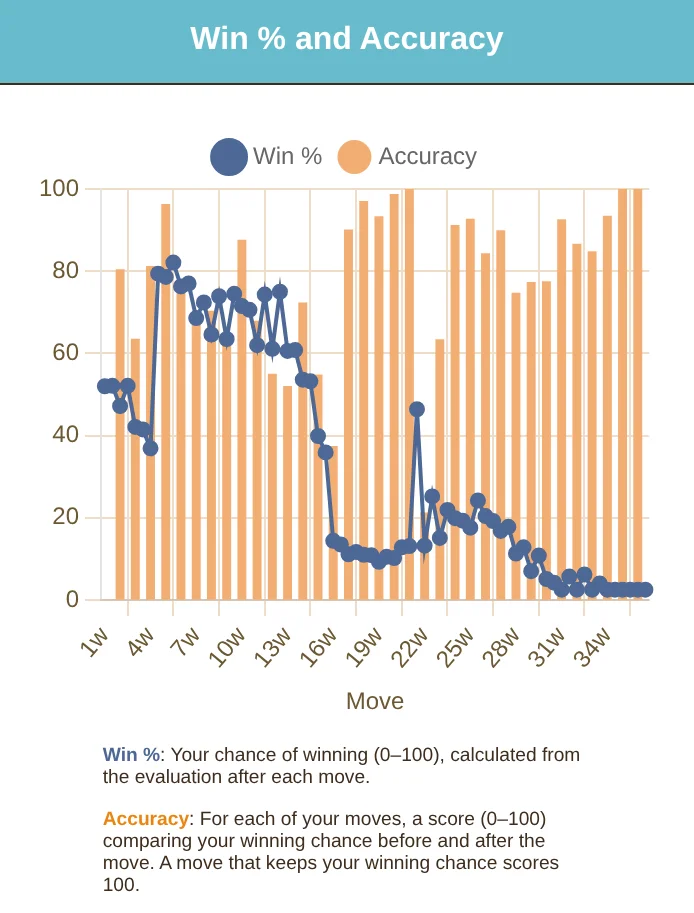 The Win % and Accuracy chart from the sample analysis page
The analysis page does not show the evaluation as it is. It turns it into a win rate (0 to 100%) and shows it as a chart, because a win rate makes it easier to see how much better one side is than an evaluation number does. For example, an evaluation of +1.5 is a win rate of about 63%. Moves that drop the win rate by 5 points or more are shown as mistakes, up to three moves.
Puzzles and lessons
For lessons, we let Bots play each other and choose games that are good for learning, such as games where the win rate swings a lot or where a player punishes the opponent's mistake.
For puzzles, we pick out positions that are good for learning tactics from your own games and from games between Bots.
Why we decided to use Stockfish
There are two reasons.
- As a chess beginner, I felt I could not get better without knowing the "answer."
- Analysis gives us something to enjoy together after a game.
I wanted the "answer"
At first, I wanted to add games against a Bot, and that is how I found Stockfish.
As I looked into it, I learned that Stockfish gives the "best move," and I thought, "I have to use this!"
When I started chess, I was always unsure during games: "Is this move right?" "There must be a better move, but I have no idea what it is."
When you study with a workbook, you cannot really understand without the answers. And watching a skilled player swing helps you improve more than swinging 100 times on your own.
As I said above, Stockfish's best move may not be the absolute "answer," but I thought it would be a good guide for beginners, so I put the best moves on the analysis page after each game.
Time together after a game
After my husband and I play on a chessboard, he often moves the pieces by himself and thinks, "I don't think this was the right move here," or "Maybe I should have played this."
Watching him, I thought it would be fun to make an analysis page after the game and show a chart of the evaluation.
Sometimes there is a position where the evaluation dropped even more than the move you were worried about, and sometimes the win rate went up where you never expected.
After the game, we talk it over while looking at the chart, look at the best move, and nod together: "Oh, I see." It is hard to do on a real chessboard, but I think it is a way to enjoy chess that only a chess app can offer.
References
- Computer chess (Wikipedia)
- Deep Blue versus Garry Kasparov (Wikipedia)
- CCRL (Computer Chess Rating Lists)
- Stockfish chess engine (Chess.com)
- Shannon number (Wikipedia)
- Stockfish 12 (official Stockfish announcement)


