 in your browser, then choose "Add to Home Screen".
Each chess piece has a point value that gives a rough idea of its strength. This article lists the piece values, explains which piece is the strongest, and shows how to use the values to judge trades. The puzzles and lessons on this site use these values too.
Contents
Chess piece values (list)
The chess piece values are as follows.
| Piece | Points | Number at the start (one side) |
|---|---|---|
 Pawn |
1 | 8 |
 Knight |
3 | 2 |
 Bishop |
3 | 2 |
 Rook |
5 | 2 |
 Queen |
9 | 1 |
 King |
No value | 1 |
At the start, each side has 39 points in total (pawns 8, knights 6, bishops 6, rooks 10, queen 9).
These values are a rough guide to how useful each piece is. They are not part of the rules, but many beginner books and chess websites use the same values.
Which piece is the strongest?
The strongest piece is the queen (9 points).
The queen can move any number of squares in any direction: up and down, side to side, and diagonally. It combines the moves of the rook and the bishop. So a single queen controls many squares and can easily attack the opponent's pieces.
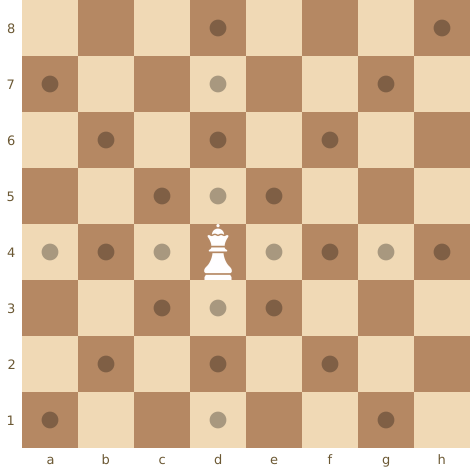 A queen in the middle of the board (d4) can move to 27 squares.
Shouldn't you move the queen early?
Even though the queen is the strongest piece, people often say you should not bring it out too early.
When I was a chess beginner, I naively thought, "Why not just take all the opponent's pieces with my queen?" I played that way, and lost my queen and the game every single time.
A common way to play the opening is: develop your minor pieces (see below) to the center, castle, and only then bring your queen into the fight.
How many points is the king worth?
The king has no point value. If your king is checkmated, you lose, so it can never be traded for other pieces.
The king moves only one square at a time, so in the opening and middlegame it is a piece to protect. But in the endgame, when few pieces are left, the king steps forward and becomes an important fighting piece.
What are major and minor pieces?
Pieces are sometimes split into two groups by strength.
| Name | Pieces |
|---|---|
| Major pieces | Queen, rook |
| Minor pieces | Knight, bishop |
The major pieces are the queen and the rook. The knight and the bishop are called minor pieces.
How do you use the values?
You use the values to judge whether you gained or lost when pieces were traded. Compare the points of the piece you took with the points of the piece you lost, and look at the difference.
| Trade | Points | Result |
|---|---|---|
| A knight for a bishop | 3 and 3 | Even |
| You lose a knight or bishop and take a rook | 3 and 5 | You gain 2 |
| You lose your queen and take a rook | 9 and 5 | You lose 4 |
Taking a rook in exchange for a knight or bishop is called "winning the exchange."
For example, look at this position from Puzzles for Everyone. White's knight jumps from b6 to d7 and attacks Black's queen (c5) and rook (f8) at the same time (a fork).
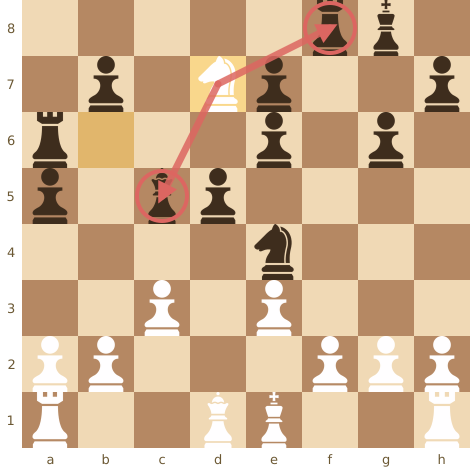 The fork 1. Nd7. Black saves the queen (9 points), so White's knight takes the rook (5 points). Even if Black then takes the knight (3 points) back, White is 2 points ahead.
Having more points in pieces than your opponent is called being "up material." When you are up material, you are usually closer to winning, because more pieces make it easier to attack the opponent's pieces and checkmate the king.
If you go after the opponent's pieces aggressively with your major pieces, lower-value pieces will chase them around, and you can easily end up losing material instead.
In the middlegame, I let my minor pieces do the attacking and try to win material with them. By the way, I think of the pawns as the wall, and the major pieces as watching over the board from behind.
As for counting points, if you add and subtract every time a piece is taken, you can lose track during a long series of trades and no longer know whether you are ahead or behind.
When that happens, I add up the points of the captured pieces shown above and below the board, and compare my total with my opponent's. Both sides start with 39 points, so whoever has captured more points is up material.
When the values don't tell the whole story
The values are only a guide. In some positions, a piece is stronger or weaker than its points suggest.
- Two bishops together (the bishop pair) are said to be a little stronger. Between them, they cover both the light and the dark squares.
- Knights are said to work well in closed positions, and bishops in open positions. A knight can jump over pieces, and a bishop reaches far.
- A pawn that is close to promoting is worth more than 1 point. If it promotes, it can become a queen.
- No matter how many pieces you have, you lose if you are checkmated. King safety comes before winning material.
How this site uses them
This site uses these values too.
- Puzzles and lessons: we use these values to check whether you end up material ahead (by 2 points or more) a few moves after the best move. We use this to choose problems for Puzzles for Everyone and the "chance" moments in Lessons.
- Captured pieces are shown above and below the board. They help you see how many points each side has captured.
- The AI evaluation is a little different from piece values. It includes not only piece values, but also how active the pieces are and how safe the kings are. For more, see "What is Stockfish? Its strength, how it works, and how to read its evaluation."
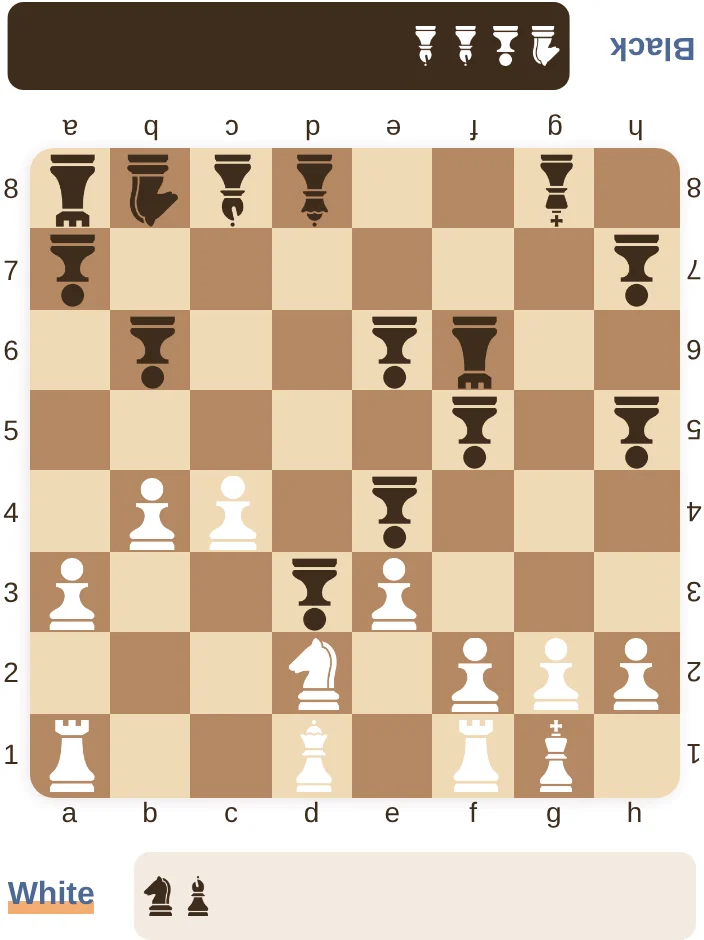 The top row shows the pieces Black captured (3 + 1 + 1 + 1 = 6 points), and the bottom row shows the pieces White captured (3 + 3 = 6 points). Both sides have captured the same points, so material is even.


