 in your browser, then choose "Add to Home Screen".
In chess, you win when you checkmate your opponent's king. This article covers the difference between check and checkmate, how to get out of check, and the basic checkmates beginners should learn first.
Contents
You win when the king can't escape
- You win at chess by putting your opponent's king in a position where it can't escape. This is called checkmate (or "mate" for short). It's the same as tsumi in shogi.
- The king is never actually captured. The game ends as soon as it's checkmate.
- Even if you've captured lots of pieces, you don't win unless you checkmate.
The difference between check and checkmate
| Meaning | What happens | |
|---|---|---|
| Check | The king is attacked by an opponent's piece | You must get out of check on your next move |
| Checkmate | The king is in check and there's no way out | The game is lost right then |
- There's no rule that you have to say "check" out loud.
- If you're not in check but have no legal moves at all, it isn't a loss but a draw (stalemate). → "Draws and Stalemate in Chess"
3 ways to get out of check
- Move the king: Escape to a square that isn't attacked.
- Capture the checking piece: You can capture it with the king or with any other piece.
- Block (put a piece in between): Put one of your pieces between the checking piece and the king. Blocking doesn't work against a check from a knight.
If you can't do any of these three, it's checkmate.
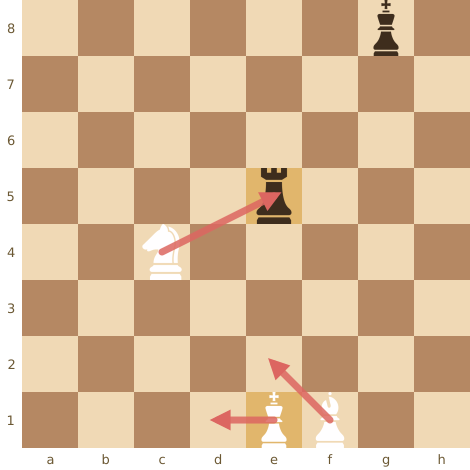 A check from the rook on e5. White can get out of it by moving the king to d1, blocking with the bishop on e2, or capturing the rook with the knight.
Resigning
- When it's clear you're going to lose, you can end the game by admitting defeat before you're checkmated. This is called resigning.
- On this site, you can resign with the "Resign" button on the game screen. In a two-player game, if both players agree, you can also make it a draw with the "Draw by agreement" button (not available in games against the bot).
Basic checkmates
These are the checkmates beginners should learn first, for endgames with only a few pieces left.
Queen + king vs. king
- Use the queen to shrink the area where the opponent's king can move, and drive it to the edge of the board.
- Finally, bring your own king close and checkmate while it protects the queen.
- If you close in with the queen alone, it's easy to stalemate by accident, so be careful.
Example: Black's king is on a8, White's queen is on b6, and it's Black's move. Wherever Black's king goes (a7, b7, or b8), the queen can capture it, and right now it isn't in check. Black has no legal moves, so it's stalemate (a draw).
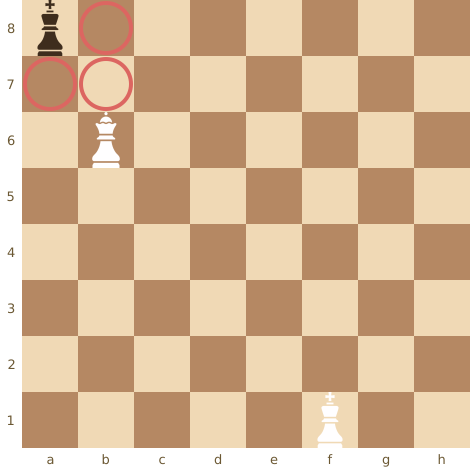 Black to move. Every square the king could move to (the 3 circled squares) is attacked by the queen, and it isn't in check, so it's stalemate.
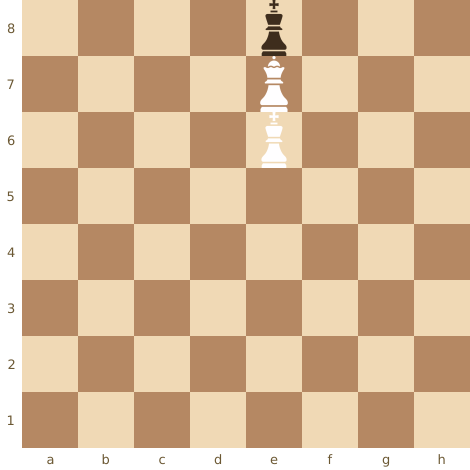 Checkmate with the queen on e7, protected by the king on e6.
Rook + king vs. king
- Use the rook to push the opponent's king toward the edge one row at a time.
- Put your king directly opposite the opponent's king, then check along the edge row with the rook.
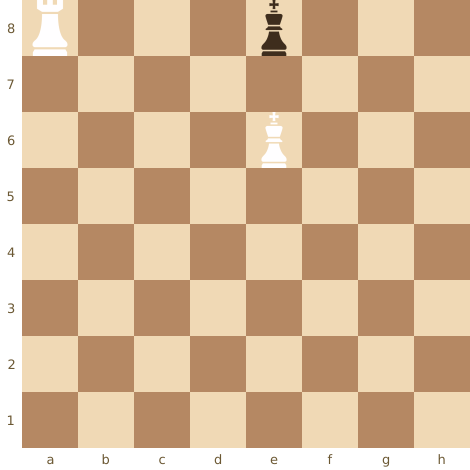 After putting the kings face to face, the rook on a8 checks along the edge row for checkmate.
With two rooks (or a queen and a rook), the ladder mate is easy: move them one row at a time, taking turns, to drive the king to the edge.
Common checkmate patterns
- Back-rank mate: The king has castled and is boxed in by its own pawns, and a rook or queen comes to the back row to checkmate. You can prevent it by moving one of the pawns in front of the king to make an escape square.
- Smothered mate: A king that can't move because it's surrounded by its own pieces is checkmated by a knight.
- Scholar's Mate: A 4-move checkmate that targets f7 (f2 for White) early in the game. → "Quick Checkmates in Chess and How to Stop Them"
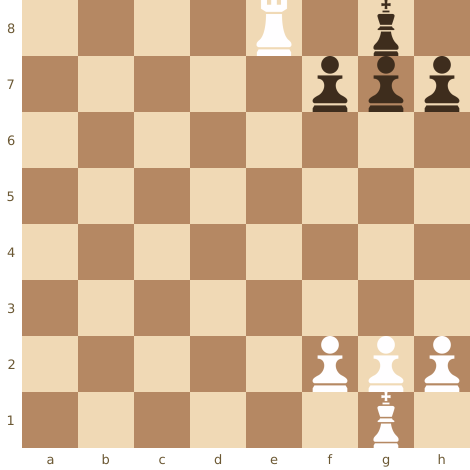 Back-rank mate. The king on g8 can't escape because its own pawns block the way.
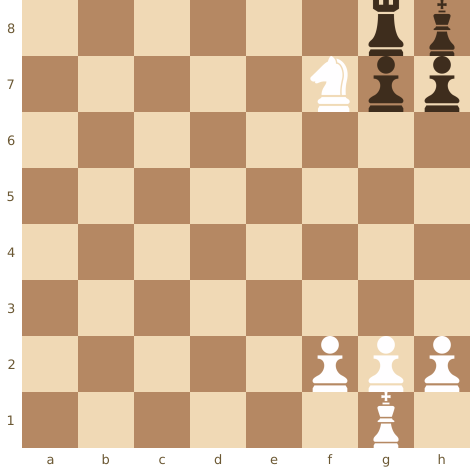 Smothered mate. The king on h8 is surrounded by its own pieces and can't escape the knight's check from f7.
How to practice
- Puzzles: There are checkmate problems.
- Playing the bot: After winning material against a low-level bot, you can practice playing all the way to checkmate. → "Chess Bot Strength in 10 Levels"
As a beginner, on the way to checkmate, you tend to want to capture your opponent's pieces so that yours won't get captured.
But if you capture too many and your opponent has only the king left to move, it becomes easy to end in stalemate.
To checkmate quickly, it's also a good idea to memorize the piece arrangements that make checkmate.


