 in your browser, then choose "Add to Home Screen".
In chess, besides winning and losing, a game can end in a draw. Stalemate in particular often happens in positions you're about to win, and it's a common way for beginners to throw away a win. This article covers the 5 ways a game ends in a draw and tips for avoiding stalemate.
Contents
Chess has many draws
- In games between strong players, draws are very common.
- There are 5 main ways a game ends in a draw:
| Condition | In short |
|---|---|
| Stalemate | It's your move but you have no legal moves, and you're not in check |
| Same position three times | The same position has been repeated |
| 50-move rule | For 50 moves, no piece was captured and no pawn moved |
| Not enough pieces | Neither side has enough pieces left to checkmate |
| Agreement | Both players decided to call it a draw |
What is stalemate?
- It's when it's your move, you have no legal moves at all, and you're not in check.
- The game is a draw right then. The side that can't move doesn't lose.
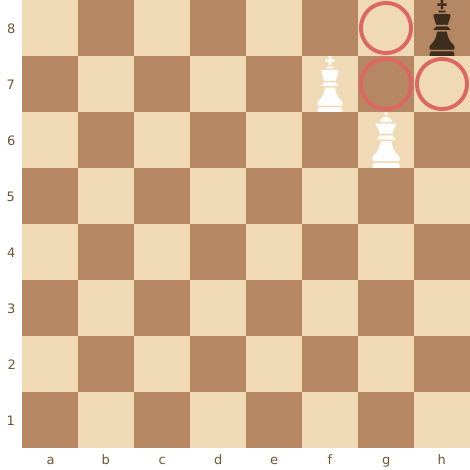 Black to move. Every square the king on h8 could move to (the 3 circled squares) is attacked, and it isn't in check. Black has no legal moves, so it's stalemate and a draw.
If you're in check and can't move, it's checkmate (a loss). If you're not in check and can't move, it's stalemate (a draw). → "What Is Checkmate?"
The same position three times (repetition)
- If the same position (the same pieces on the same squares, with the same side to move) appears 3 times, the game can be declared a draw. In Japanese, it's sometimes called sennichite, borrowing the shogi term.
- It also happens when one side keeps giving check forever and the other side can't escape. This is called perpetual check. The side that's about to lose uses it to escape with a draw.
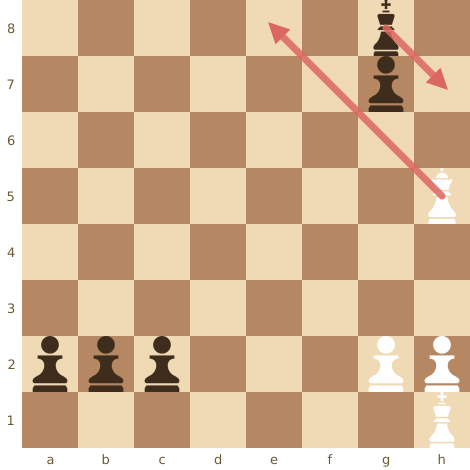 Black has more pieces and is about to promote a pawn to a queen. White can keep checking with Qe8+ Kh7 Qh5+ Kg8 Qe8+ … and make it a draw.
The 50-move rule
- If for 50 moves (50 by White and 50 by Black), neither side captures a piece or moves a pawn, the game can be declared a draw.
- This rule stops games from going on forever in positions where no one can win.
Not enough pieces
- If neither side has enough pieces left to checkmate, the game is a draw.
- Examples: king vs. king, king + bishop vs. king, king + knight vs. king.
- With king + rook or king + queen, you can checkmate.
Draw by agreement
- If both players think "neither of us can win no matter how long we play," they can agree to a draw.
- In a two-player game on this site, if both players agree, you can make it a draw with the "Draw by agreement" button on the game screen. It isn't available in games against the bot.
On this site
- Stalemate, the same position three times, the 50-move rule, and not enough pieces all end the game as a draw automatically.
- Under tournament rules, a player has to claim a draw for the same position three times or the 50-move rule. On this site, it's a draw without anyone claiming it.
- In a game with a timer, even if one side runs out of time, it's a draw if the opponent has too few pieces to checkmate.
Tips for avoiding stalemate
- Leave the opponent's king at least one square to move to: Especially when chasing the king with your queen, be careful not to box it in with moves that don't give check.
- Think about the checkmate first: Decide "where will I checkmate?" before chasing the king.
- Be careful when promoting, too: If promoting to a queen would leave your opponent with no moves, promote to a rook or another piece instead. → "What Is Pawn Promotion?"
- When you're losing, aim for stalemate: On the other hand, when you're about to lose, it's your chance to escape with a draw.
To learn the basic checkmates, see "What Is Checkmate?."


