 in your browser, then choose "Add to Home Screen".
Promotion is the rule that when a pawn reaches the far end of the board, it turns into a queen, rook, bishop, or knight. The weakest piece, the pawn, can become the strongest piece, the queen, so promotion often decides who wins the endgame.
Contents
What is promotion?
- When a white pawn reaches the 8th rank, or a black pawn reaches the 1st rank (the far end for each side), it immediately turns into another piece.
- It must change. You can't leave it as a pawn.
- Moving the pawn and changing it count as one move.
- It's similar to promotion in shogi, but in chess only pawns can promote.
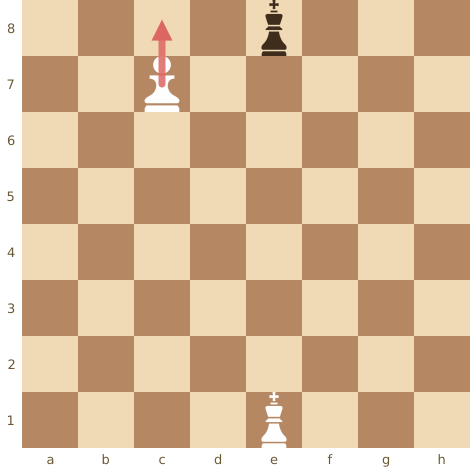 When the pawn on c7 moves to c8, it turns into a queen, rook, bishop, or knight.
What can a pawn become?
- You can choose any of these four: queen, rook, bishop, or knight.
- It can't become a king or stay a pawn.
- You can choose a piece even if you haven't lost that piece yet (even with your queen still on the board, you can make a second queen).
- In terms of piece values, a 1-point pawn becomes a 9-point queen. → "Chess Piece Values"
Can I have two queens?
- Yes. Two queens, or even three, are perfectly fine by the rules.
- When playing on a real board and you don't have a spare queen, people sometimes use an upside-down rook instead.
When should I choose something other than a queen?
You'll choose a queen almost every time. Promoting to anything other than a queen is called underpromotion, and it's used in situations like these:
- When a knight gives check or checkmate right away: The knight can make a move the queen can't (the L shape), so it reaches squares the queen can't.
- When a queen would cause stalemate: If your opponent has no legal moves, the game is a draw. Choose a rook or another piece to leave your opponent a move. → "Draws and Stalemate in Chess"
Example: White's king is on c6 and a pawn on c7, Black's king is on a7, and it's White's move.
- If you promote to a queen with c8=Q, every square Black's king could move to is attacked, and it isn't in check. Black has no legal moves, so it's stalemate (a draw).
- If you promote to a rook with c8=R, Black's only move is Ka6, and the next move Ra8# is checkmate.
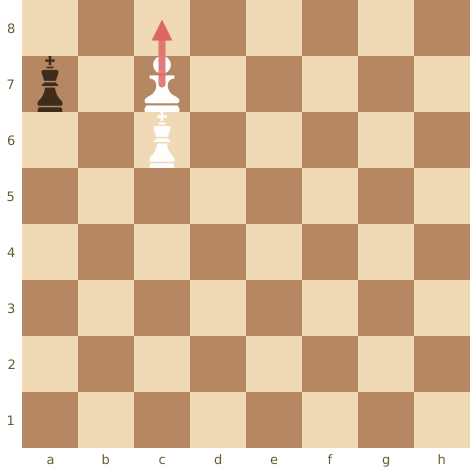 White to move. The pawn on c7 moves to c8.
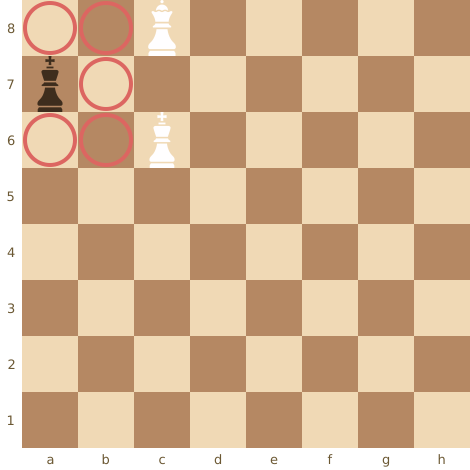 After c8=Q, every square Black's king could move to (the 5 circled squares) is attacked. It isn't in check, either, so it's stalemate.
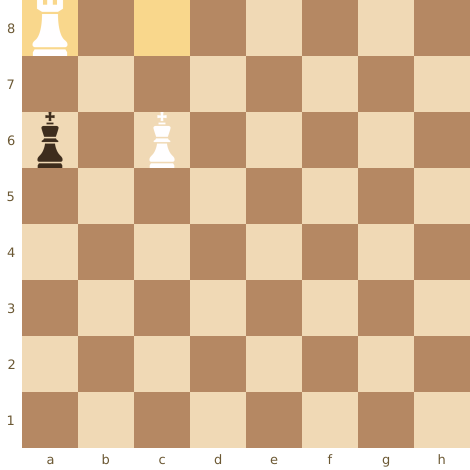 After c8=R, Black's only move is Ka6. The next move, Ra8#, is checkmate.
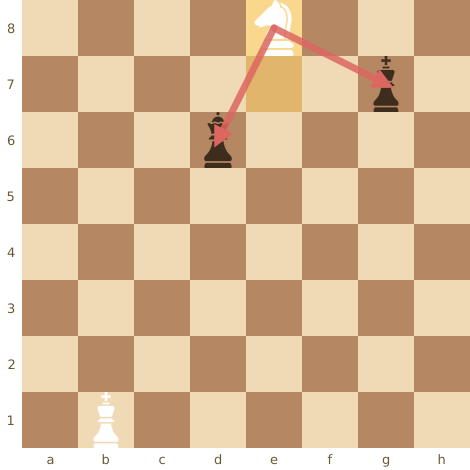 Promoting to a knight with e8=N+ gives check to the king on g7 and attacks the queen on d6 at the same time. When the king moves away, you can take the queen.
How to promote on this site
- When you move a pawn to the far end of the board, a screen for choosing a piece appears. Choose a queen, rook, bishop, or knight.
- In chess notation, it's written like e8=Q (the pawn reached e8 and became a queen). → "How to Read Chess Notation"
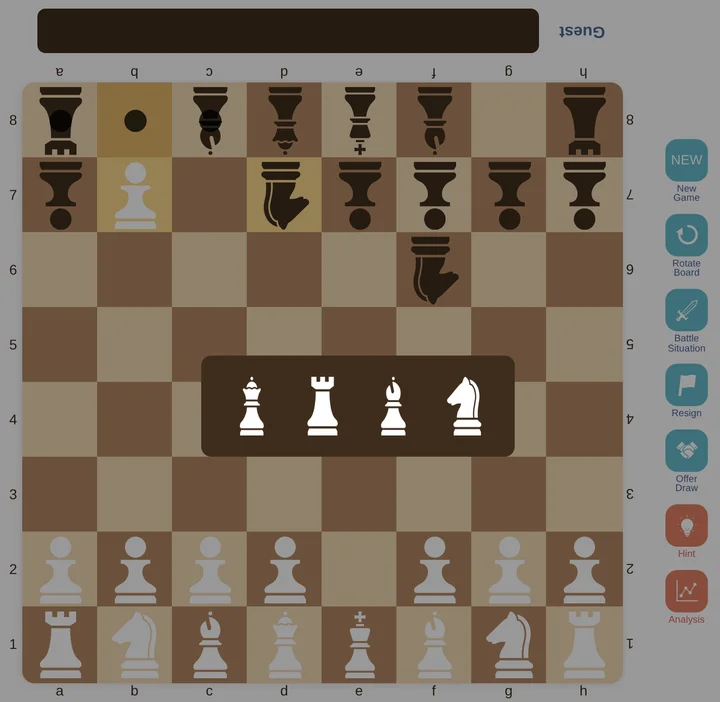 When you move a pawn to the far end of the board, a screen appears for choosing a queen, rook, bishop, or knight.
How to get a pawn to the far end
- A pawn with no enemy pawns that can stop it on its way is called a passed pawn. In the endgame, pushing a passed pawn is a powerful weapon.
- Protect the pawn's path with your pieces and actively aim for promotion.
Especially as a beginner, having a queen or not makes a big difference in how you feel when going for checkmate.
When my queen got captured in the middlegame and I was struggling to attack the king with the pieces I had left in the endgame, nothing felt more reassuring than promoting a pawn to a queen.
During a game it's easy to focus only on capturing and defending, but it's also important to keep track of the pawns that might be able to promote.


