 in your browser, then choose "Add to Home Screen".
En passant is a special rule just for pawns: you can capture an opponent's pawn that moved 2 squares diagonally, as if it had moved only 1 square. If you don't know it, you might wonder, "Why did my pawn just get captured?" So this article explains it step by step with diagrams.
Contents
What is en passant?
- En passant is French for "in passing."
- A pawn can move 2 squares on its first move only. When an opponent's pawn moves 2 squares and lands right beside your pawn, this rule lets you capture it.
When you can do it
Only when all three of these are true:
- Your pawn is at the edge of your opponent's half of the board (the 5th rank for White, the 4th rank for Black)
- Your opponent's pawn has just made its first 2-square move and landed right beside your pawn
- You capture it on the very next move
How to capture
Example: White has a pawn on e5, and Black moves a pawn 2 squares from d7 to d5.
- Black's pawn has stopped beside White's pawn (on d5).
- White can move the e5 pawn diagonally to d6 and capture Black's pawn on d5.
- The captured pawn is removed from d5, and White's pawn goes on d6.
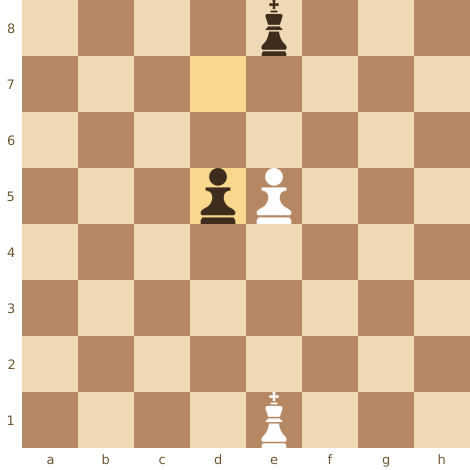 1. Black's pawn moves 2 squares from d7 to d5 and lands beside White's pawn on e5.
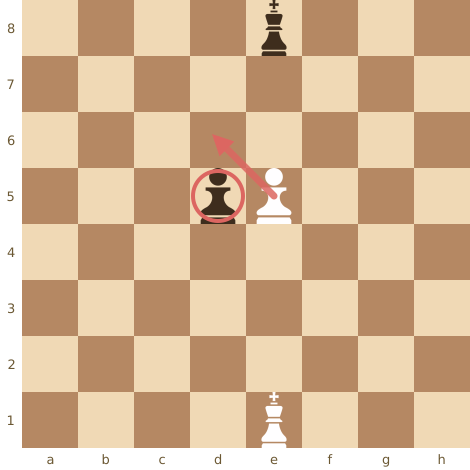 2. White can move the e5 pawn to d6 and capture Black's pawn on d5.
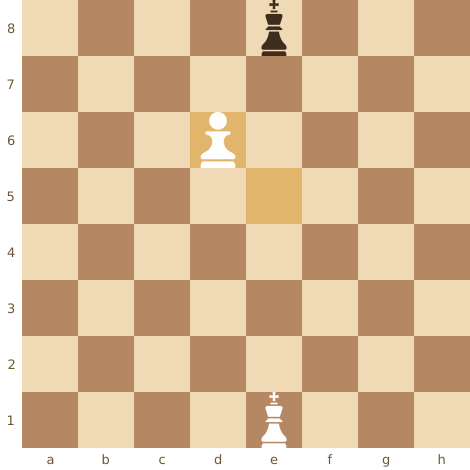 3. After the capture. White's pawn is on d6, and Black's pawn on d5 is gone from the board.
The key point is that, unlike a normal pawn capture, the square the capturing pawn lands on (d6) is different from the square of the captured pawn (d5).
You must capture right away
- You can only capture en passant on the move right after your opponent's pawn moves 2 squares.
- If you make any other move, you can't capture it later.
- You don't have to capture. Whether you do is up to you.
Why does this rule exist?
- In old chess, pawns could only move one square at a time. The rule that "a pawn can move 2 squares on its first move" was added later.
- With the 2-square move, a pawn could slip past an opponent's pawn untouched. If it had moved one square, it could have been captured, so en passant lets you capture it just as you could have in that case.
How to write it in notation
- The example above is written exd6. To make it clear it was en passant, it's sometimes written exd6 e.p.
- This site's move list writes just exd6.
- Learn more in "How to Read Chess Notation."
On this site
- When en passant is possible and you select the pawn, a dot also appears on the square diagonally ahead.
- When you play the bot, the bot will capture en passant too.
After reading the chess rulebook, I explained the rules to my husband, who had only ever played shogi, and we tried a game of chess.
But I hadn't really understood en passant, so when a chance for it came up in the middlegame, we got into an argument and ended up starting over from the beginning, haha.
It's a rule that makes sense when you read it, but leaves you going "Huh?" when you actually try it. It might be a good idea to check it by playing both sides yourself in the two-player mode.
For the other pawn moves, see "How Chess Pieces Move."


