 in your browser, then choose "Add to Home Screen".
Chess tactics are tricks that win material or deliver checkmate in one to a few moves. This article introduces the tactics beginners should learn first, along with board diagrams.
Contents
What are tactics?
- They're set patterns for winning material or delivering checkmate in one to a few moves. They're similar to tesuji in shogi.
- The long-term way of thinking about improving your position is called strategy, and it's different from tactics.
- Games between beginners are almost always decided by whether someone lost pieces to a tactic.
Fork
- One piece attacks two or more of the opponent's pieces at the same time. Your opponent can only save one, so you get to capture the other.
- Knight forks are especially common. The knight moves differently from the other pieces, so they're easy to miss.
- A fork that attacks the king and queen at the same time is very powerful.
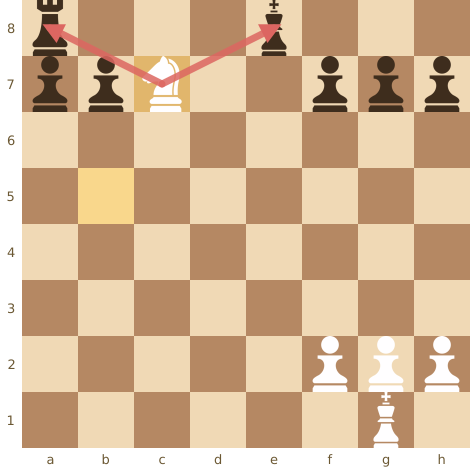 The knight on c7 attacks the king on e8 and the rook on a8 at the same time.
Pin
- When there's a valuable piece behind one of your pieces, the piece in front can't move.
- Absolute pin: The piece behind is the king. By the rules, the piece in front can't move (because the king would be captured).
- Relative pin: The piece behind is the queen or a rook. The piece in front can move, but then the piece behind gets captured.
- Pieces that move far in straight lines, like the queen, rook, and bishop, are the ones that can pin.
- A pinned piece can no longer protect other pieces, so the basic idea is to attack it some more.
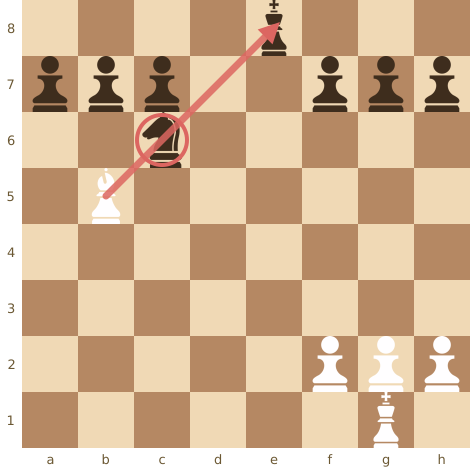 The bishop on b5 pins the knight on c6. If the knight moved, the king behind it would be attacked, so it can't move.
Skewer
- You attack a valuable piece in front, and when it moves away, you capture the piece behind it. It's the reverse of a pin.
- Example: Check the king with a rook, and when the king moves, capture the queen behind it.
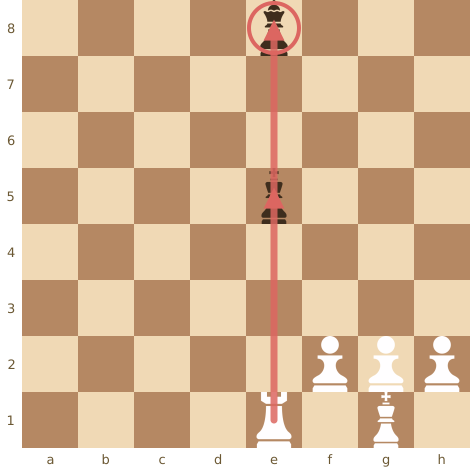 The rook on e1 checks the king. When the king moves, you can capture the queen behind it on e8.
Discovered attack
- When the piece in front moves, it opens a line for the piece behind, creating an attack.
- If the piece that moved also attacks something, you get two attacks at once.
- When the attack that opens up is a check, it's called a discovered check.
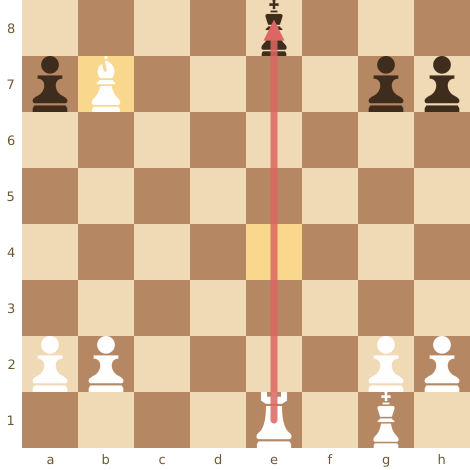 When the bishop on e4 captures the pawn on b7, the rook behind it on e1 gives check (a discovered check).
Double attack and battery
- Double attack: A move that creates two threats at the same time. A fork is one kind.
- Battery: Lining up two pieces on a straight or diagonal line so they work together. Example: Line up the queen and a bishop on a diagonal to aim at the square in front of the king.
Sacrifice
- You let your opponent capture a piece on purpose, and gain something bigger afterward.
- There are sacrifices that lead to checkmate, and sacrifices that pull a defending piece away (deflection), among others.
- Looking only at piece values it's a loss, but if you've calculated the moves that follow and it pays off, it's a good move. → "Chess Piece Values"
Example: Black's king is on h8, boxed in by pawns on g7 and h7. White has a queen on d5 and a knight on h6.
- White sacrifices the queen with Qg8+. The king can't take the queen on g8 because the knight protects it, so Black has to take with the rook on e8 (Rxg8).
- White plays Nf7#. The king is boxed in by its own pieces, so it's checkmate (a smothered mate). → "What Is Checkmate?"
White gave up the queen (9 points), but wins by checkmate.
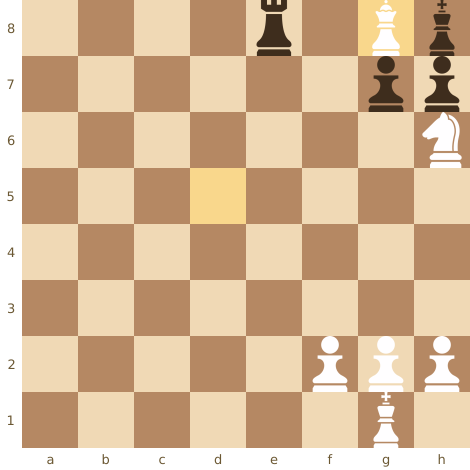 White has sacrificed the queen from d5 on g8 (Qg8+). Black has no choice but to take with the rook on e8.
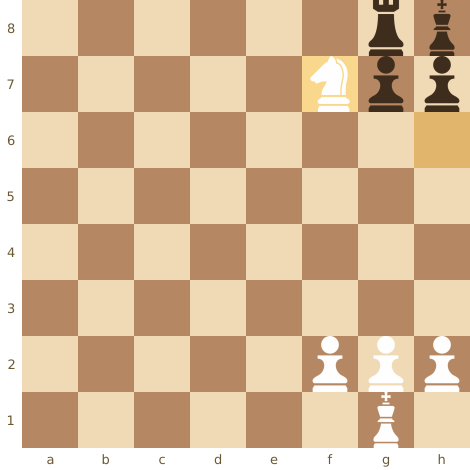 After Qg8+ Rxg8 Nf7#. Black's king is surrounded by its own pieces, so it's checkmate.
Practice with puzzles
- The fastest way to learn tactics is to see the patterns and remember them.
- Puzzles for Everyone: "Find the next move" problems made from real games. You can't choose problems by tactic, but there are forks and checkmates among them.
- Your own puzzles: If you sign up and play, you can solve puzzles made from your own game history.
- Lessons: Bot-vs-bot games with commentary on the moments where tactics appear.
- AI analysis: Find the moments in your own games where you missed a tactic. → "What Is Stockfish?"
As a beginner, I could manage forks and pins, but deliberately setting up tactics like discovered attacks and batteries was really hard.
So I first made full use of forks and pins, and tried to give it a go right away whenever I noticed during a game, "Hm? Could I pull off a discovered attack here?"


